“Office for the Arts Announces 2025 Arts Prize Winners”
(Cambridge, MA) — The Office for the Arts at Harvard and the Council on the Arts at Harvard, a standing committee of the Faculty of Arts and Sciences, announce the recipients of the annual undergraduate arts prizes for 2025.
The awards, presented to more than 224 undergraduates over the past 42 years, recognize outstanding accomplishments in the arts undertaken during a student’s time at Harvard.
Caitlin Beirne ‘25 and Adrienne Chan ‘25 are recipients of the Radcliffe Doris Cohen Levi Prize. The prize recognizes a Harvard undergraduate who combines talent and energy with outstanding enthusiasm for musical theater at Harvard. The prize honors the memory of Doris Cohen Levi ’35 and is conferred upon a student who has made a consistent contribution of high quality to the production or performance of musical comedy, opera, dance and all other forms of theater which combine music and theatrical performance at Harvard.
“Artist Profile: Adrienne Chan ’25 — Choreography as a Relationship, Dance as its Language”
Adrienne L. Chan ’25, member of the Harvard Ballet Company and choreographer of “Heathers: The Musical” and “Footloose,” among other Harvard-Radcliffe Dramatic Club productions, is an artist with a vision.
“I’m a believer in that dance can exist as its own independent art form and not in service of something else or in context of something else, that it can be isolated from music or from text or anything, and still generate a lot of meaning,” Chan said in an interview with The Harvard Crimson.
She does not consider choreography a dictatorship, rather a horizontal relationship with the performers: The creativity of both the choreographer and the performers contributes to making dance its own entity and granting it independence.
– Nicole M. Hernandez Abud, The Harvard Crimson
On Romeo & Juliet:
This Romeo & Juliet embodied that same creative audacity and dared to defy expectations. Like Gertrude Stein’s salon, which fostered unbounded imagination and bold reinvention, this production sought new paths, pushed beyond the familiar, and forged a powerful, intimate connection with each audience member—pulling us deeper into the narrative and inviting a fresh, urgent perspective on Shakespeare.
Chan and her co-choreographer Jimena Luque ’25 used Shakespeare’s text as a launchpad, transforming familiar narratives into something startlingly new. They broke the story apart and breathed new life into it. They challenged conventions, forged new connections, and created a space where love, rage, hope, and grief felt raw and immediate.
Just as Gertrude Stein’s salon fostered radical collaboration and boundary-dissolving ideation, Chan and Luque’s production also bridged artistic forms, drawing from an eclectic mix of dance styles—from Afro-Peruvian motifs to Andean folkloric rhythms—to shape a movement language that transcended traditional storytelling. We had no choice: in their presence, Shakespeare became a living, breathing force capable of connecting us to our most human selves, and not just a literary relic of the past.
– Todd Bida, The Harvard Independent

photo by Stella Gilbert
The seminal question that the production tackles is not contained to the tragic fate of Romeo and Juliet’s relationship. It aims to investigate what the interactions between their love and the cruel politics of their world tell us about our own world.
“What decisions can we make to honor the rights of children and people to love as they love?” Chan said.
An optimistic retelling of Romeo and Juliet’s cosmic, wild, and uncontrollable love may be exactly what Harvard audiences need to renew their hope for a brighter future and identify the right choices needed to get there.
“Love is the medium with which we envision an ideal future for ourselves, for our children, and politically,” Chan said.
– Saranya Singh, The Harvard Crimson
On The 25th Annual Putnam County Spelling Bee:
In songs that involved overlapping voices, such as the dizzying and spectacular “Pandemonium,” the choreography of Adrienne Chan ’25 offered all sides of the audience an excellent view while manifesting the rambunctious energy of the children in visually fun formations.
– Isabelle A. Lu, The Harvard Crimson
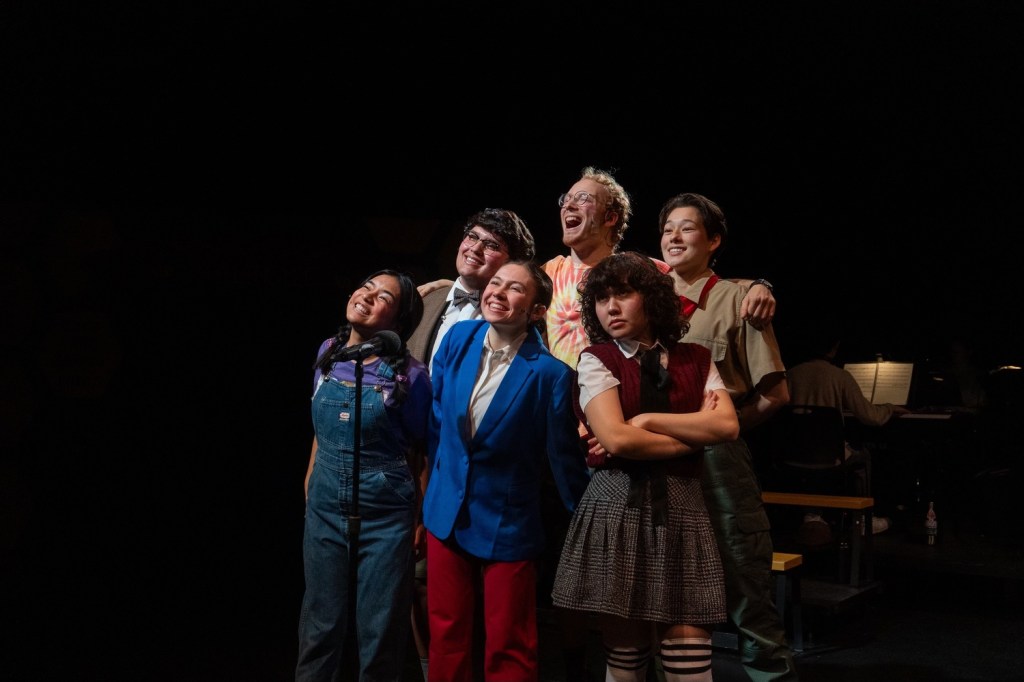
photo by Sarah Erickson
On Spring Awakening:
While the music throughout the entire two hours is often bombastic and benefits from the talented ensemble, in the dress rehearsal I watched, the deeply thoughtful choreography was incongruous with some of the excellent blocking. Even sitting in an 11-person crowd, the punk energy during “Totally F****d” at the climax of the show almost compelled me to jump out of my seat and sing along. But, this energy was developed by letting the cast run wild, jumping in tandem with the energy of the live eight-person band on stage with them. Throughout the rest of the show, the rewarding choreography was characterized by large sweeping arm movements and relatively restrained lower bodies.
– Noah Tavares, The Harvard Independent
 Adrienne Chan